
E-commerce has completely transformed the way businesses operate in the 21st century. No longer are physical stores the only route to reach customers—today, anyone with an internet connection can start selling products or services globally. But understanding how e-commerce works goes beyond setting up a store. It’s about knowing the full workflow: from product selection, platform choice, and marketing to fulfillment, customer engagement, and scaling.
At ASHS Consultants, under the mentorship of trainer Hasan Siddiqui, e-commerce is taught as a complete business ecosystem, not just a marketplace. Students don’t just learn theory—they execute practical workflows, analyze real market data, and understand how to turn ideas into revenue. This hands-on, guided approach ensures learners can operate confidently on multiple platforms and choose the model that best fits their business goals.
Learning e-commerce correctly is essential, whether you’re aiming for Amazon global sales, launching your own Shopify store, testing products on eBay, selling locally on Daraz, or starting with dropshipping. Each platform has its own workflow, advantages, and challenges—and knowing these distinctions is key to success.
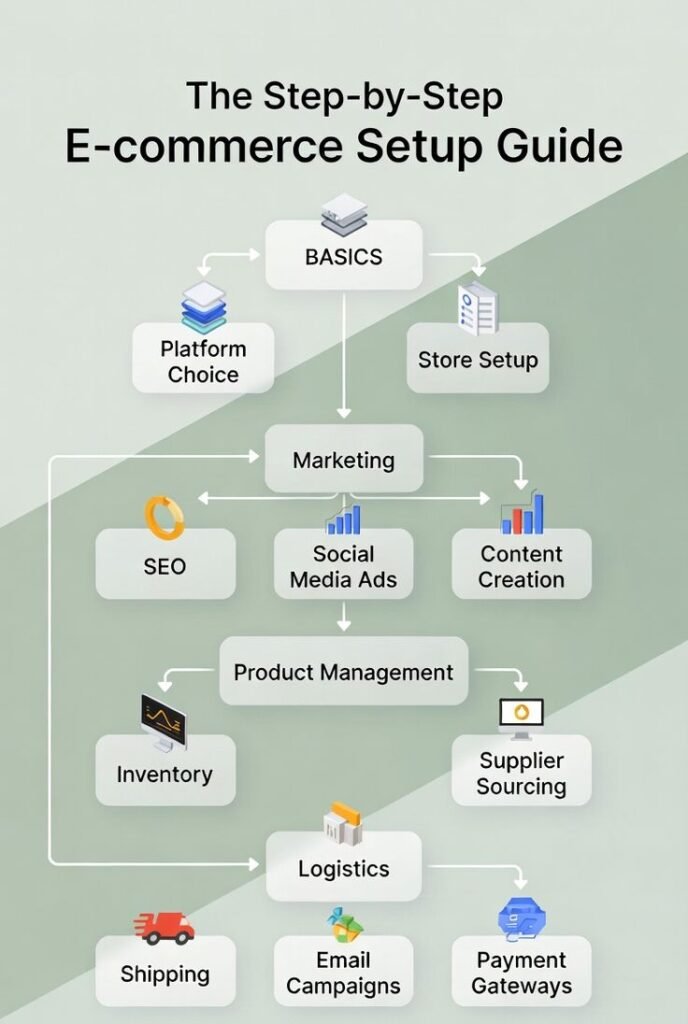
Understanding the E-commerce Process
E-commerce is not just about setting up an online store—it’s a complete system of interconnected steps that transform a product idea into real revenue. Understanding the e-commerce process explained helps beginners and aspiring entrepreneurs navigate this ecosystem with clarity, avoid costly mistakes, and build scalable businesses. At ASHS Consultants, under the guidance of trainer Hasan Siddiqui, students are trained to master every step of this workflow, ensuring practical, hands-on learning.
Here’s how the e-commerce process works in detail:
1️⃣ Product Selection & Sourcing
Every e-commerce journey begins with the product. Selecting the right product is critical for success. This includes:
-
Conducting market research to identify high-demand products
-
Understanding customer pain points and preferences
-
Deciding between physical products, digital products, or dropshipping
-
Sourcing quality items from suppliers (local or international)
At ASHS, learners don’t just read about products—they analyze real marketplaces like Amazon, Daraz, and Shopify, and learn to pick products with the highest potential for profit and scalability.
2️⃣ Platform Setup & Store Creation
Once the product is chosen, the next step is setting up the store. Choosing the right platform is crucial:
Amazon: Global reach and FBA support
Shopify: Full control over branding and customer experience
eBay: Niche or resell markets
Daraz: Local Pakistani marketplace
Dropshipping: Minimal investment, supplier-managed inventory
ASHS students get hands-on experience creating stores on these platforms and learn platform-specific strategies to maximize visibility and sales.
3️⃣ Marketing & Promotion
An online store without traffic is just a digital brochure. Marketing is the engine that drives visitors to your store:
-
SEO: Optimize product listings to rank in search results
-
Paid Ads: Google Ads, Meta Ads, and platform-specific promotions
-
Email Marketing: Engage leads and nurture repeat sales
-
Social Media Marketing: Build a brand presence and community
Under Hasan Siddiqui’s mentorship, students learn how to design campaigns, analyze results, and scale effectively—not just in theory, but by running live ads and testing strategies.
4️⃣ Order Processing & Fulfillment
After traffic and conversions, the next step is processing orders efficiently:
Payment processing and verification
Inventory management (for stocked products) or supplier coordination (for dropshipping)
Packaging and timely shipping
Providing tracking and updates to customers
ASHS training ensures learners understand the operational backbone of e-commerce, so they can deliver excellent customer experiences while maintaining smooth operations.
5️⃣ Customer Engagement & Retention
E-commerce is not a one-time transaction—it’s about building long-term relationships:
Responding to queries and managing reviews
Encouraging repeat purchases through loyalty programs or emails
Analyzing customer behavior to improve products and services
Students learn how data-driven engagement leads to higher retention, more sales, and a scalable business model.
6️⃣ Analytics & Continuous Improvement
The final step in the e-commerce process is measuring results and optimizing:
Tracking sales, traffic, and conversion rates
Identifying top-performing products and campaigns
Adjusting marketing strategies based on analytics
ASHS emphasizes practical analysis: students learn to use real data to make decisions that grow the business sustainably.
E-commerce is a full-cycle process—from product selection to customer retention. The difference between successful and failed stores lies in understanding this workflow and executing it practically. At ASHS Consultants, learners don’t just study e-commerce—they practice it in real-time, guided by Hasan Siddiqui, so they’re ready to start earning as soon as they finish the course.
Amazon is one of the world’s largest e-commerce marketplaces. Understanding how Amazon e-commerce works involves learning about product listing optimization, pricing strategies, FBA (Fulfillment by Amazon), and global shipping. Under ASHS Consultants’ guidance, students learn how to:
Select profitable products using market research
List products to maximize visibility
Handle inventory efficiently
Scale sales globally
With practical exercises, learners see firsthand how Amazon’s platform converts traffic into revenue, giving them confidence to operate at a global level.
A Shopify store allows full control over branding, design, pricing, and customer experience. Knowing how Shopify store works is critical for those who want to build a unique online brand rather than rely on a marketplace. At ASHS Consultants, students learn to:
Set up their branded online store
Integrate payment gateways and shipping solutions
Create high-converting product pages
Use marketing and analytics tools to drive sales
The focus is on creating scalable, independent brands, with every step supported by Hasan Siddiqui’s mentorship.
eBay is ideal for niche, refurbished, or specialty products. Understanding how eBay selling works involves:
Creating compelling product listings
Pricing strategies for auctions and fixed listings
Managing customer interactions and shipping
Testing products quickly with minimal investment
Students at ASHS learn practical ways to validate product ideas and generate cash flow while minimizing risk.
For local businesses in Pakistan, Daraz provides a streamlined platform to reach domestic customers. Knowing how Daraz selling works includes:
-
Registering as a seller and listing products
-
Understanding commission structures and promotions
-
Leveraging Daraz logistics for timely delivery
-
Marketing campaigns to boost visibility
ASHS mentors ensure learners understand the entire local e-commerce ecosystem, preparing them to grow brands domestically before thinking globally.
Dropshipping allows entrepreneurs to sell products without holding inventory. Learning how dropshipping works involves:
Partnering with reliable suppliers
Setting up online storefronts
Implementing marketing strategies to drive sales
Managing orders, customer service, and supplier communication
ASHS students are trained on real dropshipping scenarios, including supplier selection, profit margins, and scaling strategies, giving them confidence to launch low-risk businesses.
Many beginners fail because they know platforms but not the complete workflow. At ASHS Consultants, Hasan Siddiqui emphasizes that knowing how each platform works end-to-end—from product selection to delivery—is what separates successful e-commerce entrepreneurs from beginners. When learners practice this in real-world scenarios, they build skills that generate revenue, not just certificates.
Understanding the process also allows learners to compare platforms, experiment with different business models, and scale intelligently. Whether your goal is Amazon global sales, Shopify brand creation, or local selling on Daraz, practical knowledge is the key.
Learning how e-commerce works at ASHS is not just about watching tutorials. Under Hasan Siddiqui’s mentorship, students get hands-on training, work on live projects, and understand how to implement strategies that work in real markets. The program covers everything from platform mechanics to marketing funnels, performance tracking, and scaling operations—so learners leave ready to start their own online business confidently.
