
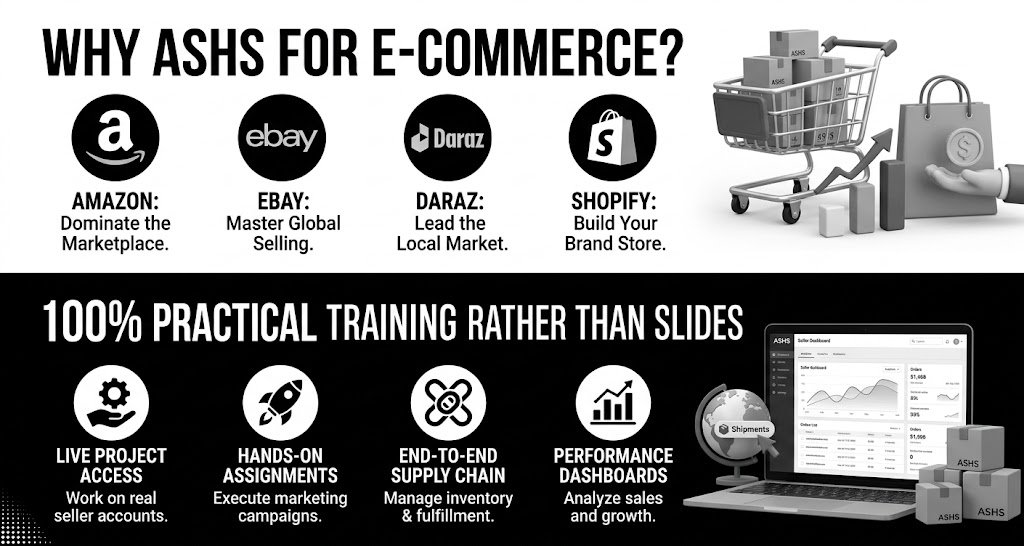
The world of online business is growing rapidly, creating exciting opportunities for people who want to learn how to sell products through international and local e-commerce platforms. From managing an Amazon store to building a Shopify website or selling products on Daraz, e-commerce skills can help students, entrepreneurs, and aspiring professionals understand how online businesses operate.
Enrolling in E-commerce Short Courses in Karachi can be a practical first step for anyone who wants to explore this growing industry and develop hands-on marketplace management skills. Whether you are a beginner or someone looking to expand your existing business knowledge, the right training can help you understand product research, product listings, order management, store operations, and the fundamentals of online selling.
If you are searching for E-commerce Short Courses in Karachi, Ashs Consultants offers a learning environment where students can explore different e-commerce business models and understand the skills required to work with popular online marketplaces. With guidance from trainer Hasan Siddiqui, learners can develop a clearer understanding of how platforms such as Amazon, Shopify, eBay, Daraz, and CJ Dropshipping work. The goal is to make complex e-commerce concepts easier to understand and connect theoretical knowledge with practical business scenarios.
Choosing the right E-commerce Short Courses in Karachi also means understanding which platform best matches your interests and career goals. Some learners may want to explore Amazon selling, while others may be interested in managing Shopify stores, selling on eBay, reaching Pakistani customers through Daraz, or learning about the CJ Dropshipping business model. By exploring these options through structured training at Ashs Consultants
Amazon is one of the most widely recognized e-commerce marketplaces, offering sellers an opportunity to list products for customers in supported markets.However, successful marketplace management involves much more than uploading a product and waiting for orders.
Sellers need to understand product research, competition, listing quality, inventory planning, customer service, marketplace policies, and business expenses. For beginners interested in Amazon, structured training can help break these responsibilities into manageable learning areas and explain how different selling models operate.
An Amazon FBA course in Karachi may be relevant to learners who want to understand Fulfillment by Amazon. Under this model, eligible sellers send inventory to Amazon’s fulfillment network, where Amazon handles designated storage, packing, shipping, and customer-service processes according to its terms.
Students should also understand that FBA does not remove every seller responsibility: product selection, inventory planning, account compliance, profitability, and advertising decisions remain important.
Another learning pathway is the Amazon wholesale course in Karachi. Wholesale generally involves sourcing genuine products from established brands, manufacturers, or authorized distributors for resale. This approach requires an understanding of supplier verification, invoices, product restrictions, competition, pricing, and profit margins. A course covering wholesale should explain how to assess potential suppliers and why sellers must follow Amazon’s documentation and authenticity requirements.

What should an Amazon course cover?
A well-structured program may introduce students to:
Amazon Seller Central and its main features.
Product research and competitor analysis.
Listing creation, product titles, images, and descriptions.
Basic keyword research for Amazon product listings.
FBA and wholesale business models.
Inventory planning and order management.
Amazon PPC fundamentals and advertising costs.
Account health, marketplace policies, and performance reporting.
Product research deserves particular attention because choosing a product without examining demand, competition, sourcing costs, and fees can lead to poor business decisions. Learners should practice evaluating several product opportunities instead of assuming that a popular product will automatically be profitable.
When comparing an Amazon FBA course in Karachi with other training options, ask whether the course explains practical workflows, provides exercises, and teaches students how to interpret marketplace information. Also confirm whether live Seller Central access is included or whether demonstrations and simulated exercises are used. This distinction helps students understand exactly what they will learn before enrolling.
For learners exploring E-commerce Short Courses in Karachi, Amazon training can provide a useful introduction to international marketplace operations. However, selling eligibility, payment arrangements, shipping options, taxes, and account requirements vary by country and business circumstances. Students should verify the current requirements for their intended marketplace before investing in inventory or launching a business.
Shopify Store Management: Build an Online Store That Works Beyond the Marketplace
Unlike a marketplace where multiple sellers list products on the same platform, Shopify allows businesses to create and manage their own online storefronts. This makes it an interesting option for entrepreneurs who want greater control over their store’s presentation, product catalog, customer experience, and brand identity. Shopify can support different types of online businesses, but operating a store successfully requires planning, ongoing management, and an understanding of how the different store functions work together.
A Shopify store management course in Karachi can introduce learners to the practical tasks involved in running an online shop. These tasks may include setting up a storefront, organizing product categories, adding product images, writing descriptions, maintaining inventory, managing customer orders, and configuring available shipping and payment options. Students can also learn how to review store performance and identify areas that may need improvement.
From store setup to daily operations
The first stage of Shopify learning usually involves understanding the store dashboard and its main features. Students need to know how products are added, how collections are organized, and how customers move through the purchasing process. A clear navigation structure and accurate product information can make it easier for shoppers to understand what a store offers.
The next step is product catalog management. Product titles should clearly identify items, descriptions should explain relevant features, and images should represent the products accurately. Inventory records must also be maintained so that businesses can manage product availability and reduce avoidable order problems.
Order management is another important skill. Learners should understand how to review new orders, check fulfillment status, communicate with customers, and handle returns according to store policies. Payment and shipping settings also require attention because available options depend on the seller’s location, business setup, and the countries being served.

Shopify store management is not limited to creating a website. A business owner also needs to consider customer trust, mobile usability, product organization, store speed, clear policies, and the overall shopping experience. Even a visually attractive store may struggle if product information is incomplete or customers cannot easily understand the checkout process.
For students comparing E-commerce Short Courses in Karachi, Shopify training may be suitable if they want to understand direct-to-consumer online stores and their day-to-day operations. Before joining, ask whether the course includes guided store-building exercises, product uploads, inventory tasks, order workflows, and practical demonstrations.
It is also important to distinguish store management from business profitability. A Shopify store does not automatically generate sales simply because it has been created. Product demand, pricing, customer experience, supplier reliability, and the ability to attract relevant visitors all influence business performance. Learning the operational side first gives beginners a stronger foundation for understanding these broader challenges.
eBay is an established online marketplace where eligible sellers can offer products across a variety of categories. Depending on the market and selling arrangement, sellers may work with new items, used goods, collectibles, accessories, electronics, and other permitted products. The platform has its own listing procedures, seller standards, fees, shipping requirements, and customer-service expectations, which makes marketplace-specific knowledge valuable for beginners.
An eBay short course can help students understand how the marketplace operates and what is involved in managing a seller account. Rather than focusing only on creating listings, useful training should explain how sellers research products, assess competition, determine prices, prepare accurate descriptions, and manage the order process.
Product research and listing quality on eBay
Product research is an essential part of successful eBay selling. Students enrolling in an eBay short course can learn how to identify product opportunities, analyze competitors, and calculate shipping costs and profit margins. Effective eBay product research also involves creating optimized listings with accurate titles, clear descriptions, and quality images. For anyone considering an eBay short course in Karachi or an eBay course in Pakistan, understanding product selection, listing optimization, shipping, and seller policies provides a useful foundation for managing an eBay store.

Choosing an eBay course in Pakistan
People searching for an eBay short course Karachi or an eBay course in Pakistan should check whether the training is relevant to their intended business model and location. Account eligibility, selling features, payment arrangements, shipping services, and access to particular marketplace functions can vary by country and may change over time.
A useful course should explain these limitations rather than promising that every student can immediately open a seller account or start earning. Ask whether the training covers listing creation, product research, pricing, customer communication, order handling, and seller policy compliance.
For students exploring E-commerce Short Courses in Karachi, eBay can be worth considering if they are interested in marketplace operations and product-based selling. The most valuable outcome is a practical understanding of how to evaluate opportunities, create accurate listings, and manage customer expectations—not simply learning where to click inside a dashboard.
Daraz Seller Training: Take Your Products into Pakistan's Online Marketplace
For learners interested in selling within Pakistan, Daraz provides a marketplace environment that is especially relevant to local e-commerce. It allows participating sellers to present products to online shoppers through the platform, subject to its seller requirements, category rules, and operating procedures. This can make Daraz a practical subject for students who want to understand how local marketplace selling differs from operating an independent online store or selling internationally.
A Daraz seller course in Karachi can introduce learners to the key activities involved in managing a Daraz seller account. These may include seller registration, product listing, catalog organization, pricing, stock updates, order processing, and customer-related responsibilities. Understanding these processes can help new sellers prepare for the operational demands of online retail.

Product listings and catalog management
A product listing should make it easy for customers to understand what is being offered. Learners should practice writing relevant product titles, selecting accurate categories, adding clear photographs, and providing complete specifications. Depending on the category, this may involve sizes, colors, material details, technical features, or compatibility information.
Accurate information is important because customers rely on listings to make purchasing decisions. Missing specifications, misleading images, or unclear descriptions can lead to customer dissatisfaction and avoidable returns. Sellers should therefore learn to review listings carefully before publishing them and keep product information updated when details change.
Orders, inventory, and seller performance
Daraz seller operations also involve monitoring incoming orders, preparing products for dispatch, updating stock levels, and following the platform’s current fulfillment procedures. Inventory management is particularly important when products are sold through more than one channel. Without accurate records, sellers may accept orders for products that are unavailable.
Students should also become familiar with the seller dashboard and the performance information available through their accounts. Depending on the features currently provided, this information may help sellers monitor orders, sales, returns, and other operational indicators. Understanding the platform’s seller standards can help businesses identify problems and maintain more consistent service.
Is Daraz training right for beginners?
A Daraz-focused course may be useful for students who want to learn about online retail within Pakistan, existing shop owners looking to explore online sales, or entrepreneurs who want to understand marketplace operations before launching a store.
When evaluating E-commerce Short Courses in Karachi, check whether the institute provides a clear outline of Daraz-related topics and whether learners get opportunities to practice listing and order-management tasks. It is also worth asking how the course explains seller policies, product eligibility, fees, and fulfillment requirements.
CJ Dropshipping Course: Understand Product Sourcing, Suppliers, and Fulfillment
Dropshipping is an e-commerce model in which a seller offers products to customers without necessarily keeping all the inventory in their own premises. When an order is placed, the supplier or fulfillment partner may handle designated parts of product preparation and shipping. This model can reduce the need to purchase and store large amounts of inventory upfront, but it still requires careful product selection, supplier coordination, customer service, and financial planning.
CJ Dropshipping is a service associated with product sourcing and fulfillment for online sellers. Learners interested in this model may benefit from understanding how suppliers, storefronts, order information, shipping arrangements, and customer expectations connect throughout the purchasing process.
A CJ Dropshipping course in Karachi can be relevant to students who want to explore this type of e-commerce workflow. However, course content should explain the responsibilities of the seller as well as the services that a supplier or fulfillment platform may provide.

How product sourcing works
Product sourcing involves identifying products that may fit a target market and then evaluating whether they are suitable for a particular business. Students should learn to consider product quality, supplier information, shipping times, availability, potential returns, and total costs before making decisions.
The listed product price is only one part of the calculation. A seller may also need to account for shipping charges, platform fees, payment processing, refunds, customer-service costs, and other business expenses. Comparing these factors helps learners evaluate whether a product has a reasonable potential margin.
Supplier reliability matters as well. Sellers should understand how to review product information, request clarification when necessary, and communicate about stock or fulfillment problems. They should avoid making delivery promises that cannot be supported by the supplier’s actual shipping arrangements.
Order fulfillment and customer experience
Once a customer places an order, the seller needs a clear process for handling the purchase and monitoring its progress. Depending on the business setup and available integrations, some order information may be transferred between the store and fulfillment provider. Learners should understand how to check order details, confirm product variants, review shipping information, and monitor tracking updates.
Customer service remains the seller’s responsibility even when a third party handles fulfillment. If a shipment is delayed or an item arrives incorrectly, the seller may still need to communicate with the customer and work with the supplier to resolve the issue.
What should students learn?
A useful CJ Dropshipping course in Karachi should cover product sourcing, supplier evaluation, basic cost calculations, order workflows, shipping considerations, and customer-service processes. It should also explain that delivery times, product availability, integrations, and services vary according to the supplier and destination.
For anyone comparing E-commerce Short Courses in Karachi, this topic can provide insight into an alternative online retail model. Still, dropshipping is not a guaranteed income source. Competition, advertising costs, shipping delays, product quality, refunds, and customer expectations can affect a business. Students should learn to evaluate these factors before committing money to a store or product.
Choose the Right Learning Path: Why Consider Ashs Consultants and Trainer Hasan Siddiqui?
Choosing an e-commerce training program is an important decision, particularly for beginners who are still trying to understand the differences between marketplaces and online business models. A useful course should provide a clear learning structure, explain the practical tasks involved in online selling, and help students understand what they can realistically expect to learn. For those researching an ecommerce institute in Karachi, it is worth comparing the course outline, training format, instructor experience, practical exercises, and support arrangements before enrolling.
Ashs Consultants and trainer Hasan Siddiqui and co-trainer Muhammad Zaid are relevant names to explore if you are considering e-commerce training. Before making a decision, prospective students should request a detailed outline of the available modules and confirm which platforms are covered in the program they intend to join. Amazon, Shopify, eBay, Daraz, and CJ Dropshipping each involve different workflows, so it is useful to understand whether the course covers all of them or focuses on selected platforms.
Build skills with a realistic plan
Students do not need to master every platform at once. Beginners can start by understanding general e-commerce concepts, then explore one marketplace in greater depth. Someone interested in international marketplace operations might begin with Amazon or eBay, while a learner interested in creating a branded storefront may prefer Shopify. Students who want to understand local marketplace selling may explore Daraz, and those curious about supplier-based fulfillment can investigate CJ Dropshipping.
The most useful next step is to practice consistently, keep learning about platform policies, and build an understanding of the responsibilities involved in managing an online business. Completing a course can provide a foundation, but long-term progress also depends on continued practice, market research, and adapting to changing platform requirements.
For people looking for short ecommerce courses in Karachi, Ashs Consultants may be one option to investigate. Review the current course details, ask about the modules taught by Hasan Siddiqui, and confirm which practical activities are included before making your final choice.
Your Digital Future Starts Here — Learn, Launch & Lead with Ashs Consultants!
Take the next step toward your online career with Ashs Consultants, where you can learn more than just e-commerce. Explore practical training in SEO, AEO, GEO, Meta Ads, Google Ads, freelancing, TikTok Shop, Amazon, Shopify, eBay, Daraz, and CJ Dropshipping—all designed to help you develop valuable digital skills and understand how online businesses operate.
Learn from our three expert trainers, each specializing in a different area:
-
Sir Hasan Siddiqui – E-commerce and Digital Marketing Expert
-
Awais Zafar – Digital Marketing Expert
-
Muhammad Zaid – TikTok Shop and E-commerce Expert
Whether you want to start an online store, offer digital marketing services, explore freelancing, or learn how to manage e-commerce platforms, Ashs Consultants can help you build a stronger foundation with expert guidance.
Don’t wait to start learning skills for the digital world! Contact Ashs Consultants today to explore our courses and find the right learning path for your goals.